

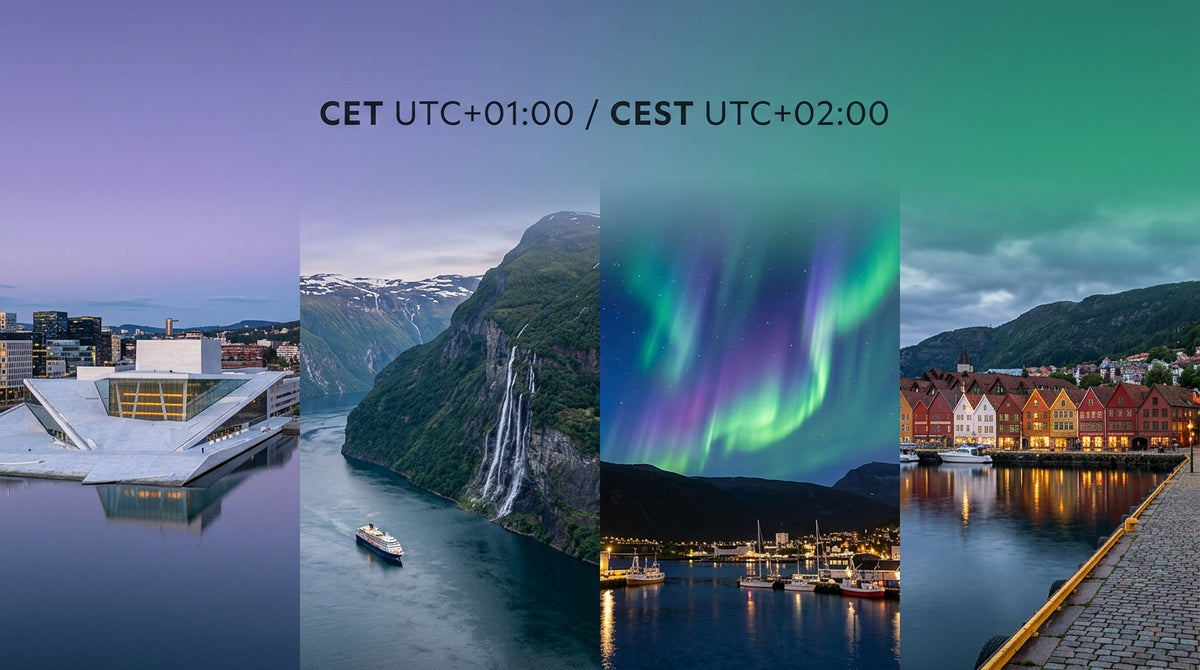
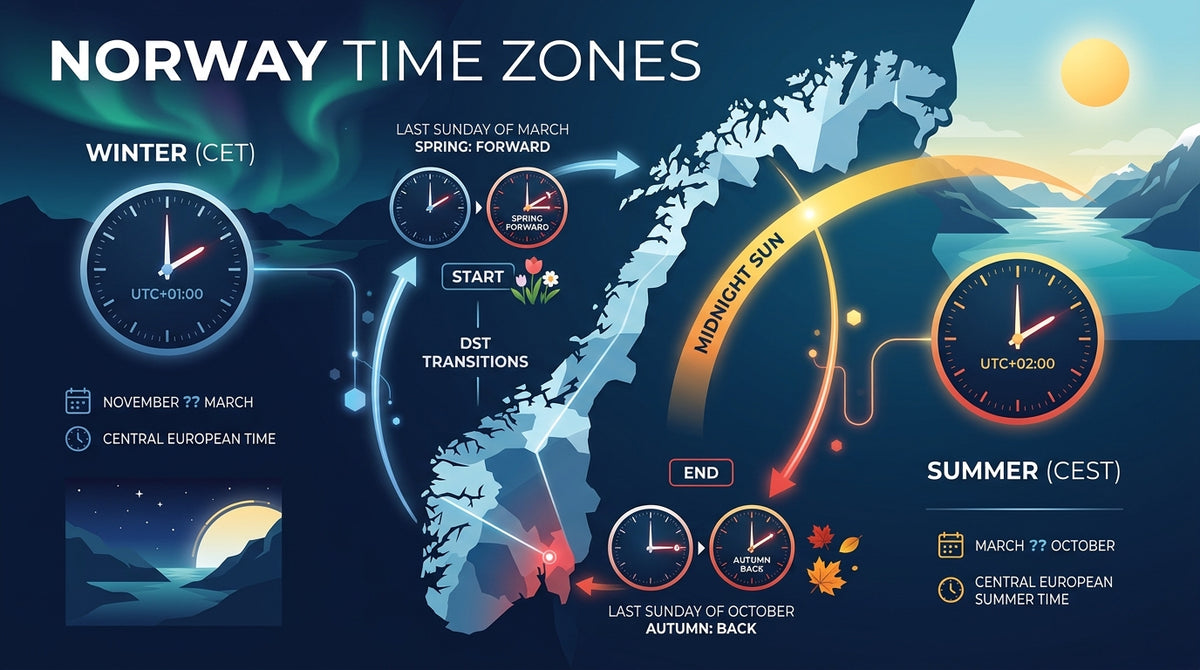
Norway stretches from the North Sea at 57°N to the high Arctic at 80°N — a country where summer means the midnight sun above Tromso and winter brings polar nights when the sun never rises. Yet the entire country runs on one clock: Central European Time (CET, UTC+01:00) in winter, Central European Summer Time (CEST, UTC+02:00) in summer. Mainland Norway, Svalbard and Jan Mayen all share the same offset, despite the geographic stretch. Norway observes EU-aligned daylight saving twice a year even though it is not an EU member. Here is where Norway actually sits, why, and what it means when you're calling Oslo from anywhere else.
Norway Time at a Glance
| Time zone | CET (UTC+01:00) |
|---|---|
| IANA identifier | Europe/Oslo |
| Daylight saving | Yes — starts Last Sunday of March, 01:00 UTC, ends Last Sunday of October, 01:00 UTC |
| DST abbreviation | CEST (UTC+02:00) |
| Number of zones | 1 |
| Capital | Oslo |
| Latitude / Longitude | 59.9139° N, 10.7522° E |
| Elevation | 23 m / 75 ft (Oslo) |
| Currency | Norwegian Krone (NOK, kr) |
| Languages | Norwegian, Sami, English |
| Country code | NO / +47 |


Live Time Differences from Around the World
Live comparison between Oslo and major reference cities. Each row updates every minute against your browser's clock.
| City | Local time now | In Oslo | Difference |
|---|---|---|---|
| London (GMT/BST) | — | — | — |
| New York (EST/EDT) | — | — | — |
| Los Angeles (PST/PDT) | — | — | — |
| Sydney (AEST/AEDT) | — | — | — |
| Tokyo (JST) | — | — | — |
| Singapore (SGT) | — | — | — |
| Dubai (GST) | — | — | — |
| Mumbai (IST) | — | — | — |
| São Paulo (BRT) | — | — | — |
| Johannesburg (SAST) | — | — | — |
| Auckland (NZST/NZDT) | — | — | — |
| Anchorage (AKST/AKDT) | — | — | — |
| Toronto (EST/EDT) | — | — | — |
| Chicago (CST/CDT) | — | — | — |
| Bangkok (ICT) | — | — | — |
| Jakarta (WIB) | — | — | — |
| Seoul (KST) | — | — | — |
Live comparison requires JavaScript. Static fallback values shown above.
Daylight Saving Time in Norway
DST starts: Last Sunday of March, 01:00 UTC
DST ends: Last Sunday of October, 01:00 UTC
Next transition in Norway
Calculating…
Best Hours to Reach Norway
Norwegian Business Hours and Public Holidays
Midnight Sun, Polar Night, and Jet Lag
From 1895 CET to Modern EU-Aligned DST
Nearby Nordic and European Time Zones
Frequently Asked Questions
What time zone is Norway in?
Norway observes Central European Time (CET, UTC+01:00) in winter and Central European Summer Time (CEST, UTC+02:00) from the last Sunday of March to the last Sunday of October. Oslo, Bergen, Tromso, Lofoten and Svalbard all share this single zone.
What is the time difference between Norway and the United States?
Oslo is six hours ahead of New York and nine hours ahead of Los Angeles year-round. The gap drops by an hour for two short windows each year (typically a week in March and a week in November) when one country has switched to summer time and the other hasn't.
Does Norway observe daylight saving time?
Yes. Norway shifts to Central European Summer Time at 1 a.m. UTC on the last Sunday of March, then back to CET at 1 a.m. UTC on the last Sunday of October — the same dates as the EU, despite Norway not being an EU member.
When does daylight saving start and end in Norway in 2026?
CEST runs from Sunday 29 March 2026 through Sunday 25 October 2026. The transitions always happen at 1 a.m. UTC, which is 2 a.m. local time in spring and 3 a.m. local time in autumn.
How many time zones does Norway have?
Norway observes one time zone (CET/CEST). The same zone covers mainland Norway, Svalbard in the high Arctic and the volcanic island of Jan Mayen.
What is the best time to call Norway from the US?
Call between 9 a.m. and 11 a.m. Eastern Time, which lands you in Oslo between 3 p.m. and 5 p.m. (comfortably mid-afternoon for Norwegian office workers). Don't schedule after 4 p.m. Oslo time — Norwegians end the workday on time.
What time zone is Oslo in?
Oslo sits in Central European Time (CET in winter, CEST in summer). The live clock at the top of this article shows the current Oslo time.
Was this article helpful?
Thanks for your feedback!